
If you work with hydraulic or pneumatic systems, you’ve likely encountered the challenge of managing fluid flow across multiple circuits — cleanly, reliably, and without a maze of external plumbing. That’s exactly the problem directional control valve manifolds are designed to solve.
Whether you’re running heavy construction equipment, an industrial automation line, or an aerospace hydraulic system, the right manifold can mean the difference between a clean, efficient design and one that’s costly to maintain and prone to failure. In this guide, we’ll break down what directional control valve manifolds are, how they work, and what to look for when selecting one.
What Is a Directional Control Valve Manifold?
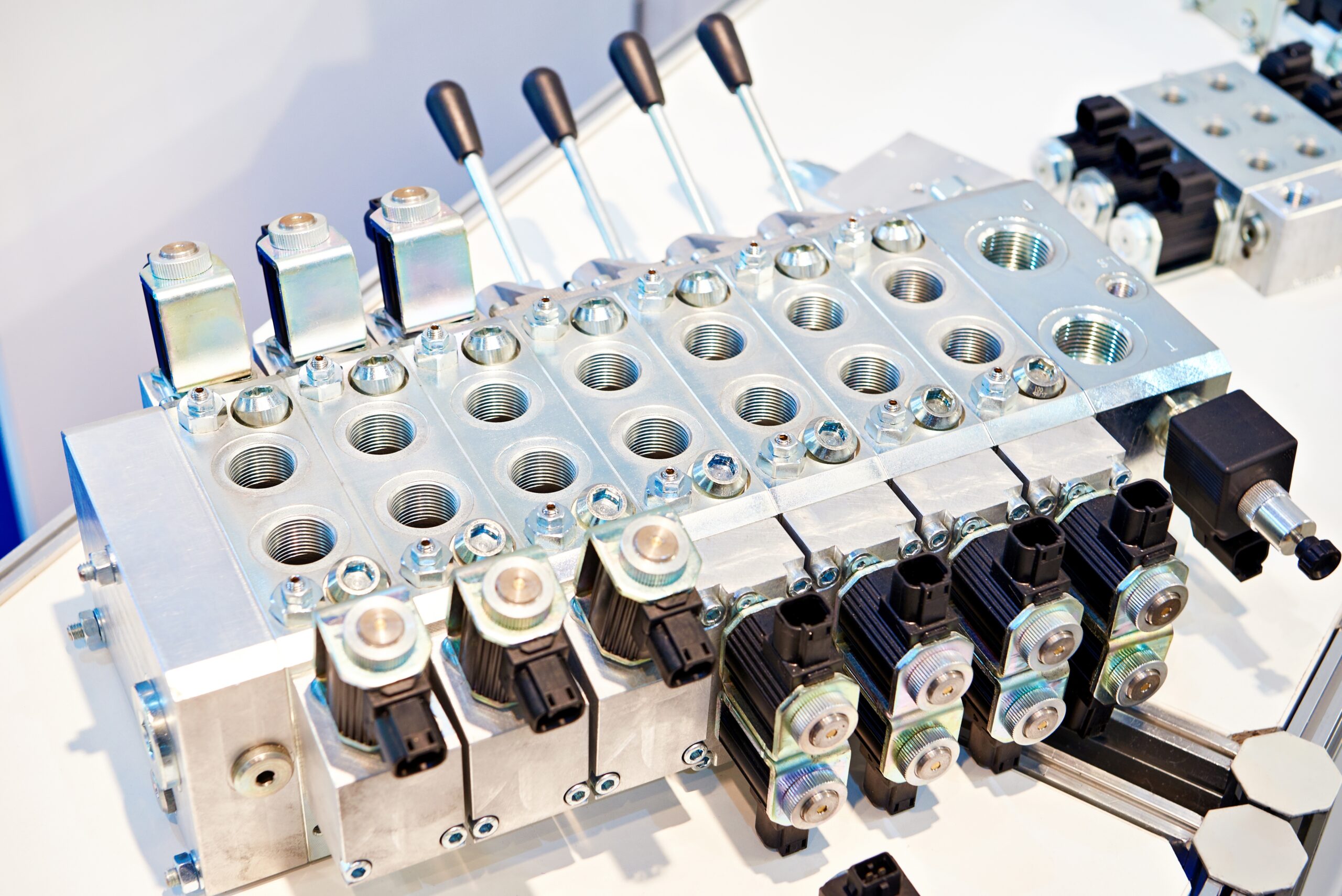
A directional control valve manifold is a machined block, typically aluminum or ductile iron, that houses multiple directional control valves and internal fluid passages in a single, integrated unit. Rather than connecting individual valves with external hoses and fittings, a manifold routes hydraulic or pneumatic fluid through precision-drilled internal channels.
Think of it as the central nervous system of your fluid power circuit. The manifold receives fluid from the pump, routes it to the appropriate valve stations, and directs it to the actuators — cylinders, motors, or other devices — that do the actual work.
Directional control valves themselves determine which direction fluid flows through a circuit and when. Common configurations are described by the number of ports (ways) and positions they control, such as 4/2 (four ports, two positions) or 4/3 (four ports, three positions). When these valves are integrated into a manifold, the result is a compact, leak-resistant, and highly configurable control assembly.
Key Benefits of Using a Manifold-Based Design
Switching from a traditional plumbed system to a manifold-based design offers meaningful advantages in both performance and long-term cost:
Fewer Leak Points – Every external fitting and hose connection is a potential leak point. Manifolds eliminate most of those connections by routing fluid internally, dramatically reducing the risk of leaks and the maintenance time required to address them.
Space Savings and Cleaner Installations – A manifold consolidates what might otherwise be dozens of individual components into a single, compact block. This is particularly valuable in mobile equipment and aerospace applications where space is at a premium.
Faster Installation and Commissioning – Because the manifold arrives pre-assembled and pre-tested, installation time on-site is significantly reduced. There’s no need to individually mount, pipe, and bleed multiple valves. The manifold is essentially plug-and-play.
Improved System Efficiency – Shorter, optimized internal flow paths reduce pressure drop across the system. Less pressure loss means the pump doesn’t have to work as hard, which translates to lower energy consumption and reduced heat generation.
Custom Configurations – Unlike off-the-shelf valves with fixed form factors, manifolds can be designed with the exact port configurations, flow paths, and valve combinations your application requires. This level of customization makes them ideal for complex, multi-function systems.
Common Industries and Applications
Directional control valve manifolds are used wherever precise, multi-circuit fluid control is needed. Some of the most common applications include:
- Agriculture: Tractors and harvesting equipment use hydraulic manifolds to control implements like loaders, plows, and backhoe attachments with precision.
- Construction: Excavators, cranes, and hydraulic presses rely on manifolds to manage the high-pressure fluid circuits that power booms, buckets, and clamps.
- Manufacturing & Industrial Automation: Assembly lines and CNC machinery use manifold-controlled pneumatic and hydraulic circuits to actuate clamps, presses, and transfer mechanisms.
- Material Handling: Automated warehouses and conveyor systems use manifolds to control lift tables, sorters, and pallet handlers.
- Aerospace: Aircraft hydraulic systems use lightweight manifolds to control flight surfaces, landing gear, and braking systems — where reliability and weight savings are non-negotiable.
How to Choose the Right Directional Control Valve Manifold
Selecting the correct manifold for your application isn’t just about finding a part that fits — it’s about matching the manifold’s capabilities to the demands of your system. Here are the critical factors to evaluate:
- Flow Rate Requirements – Every manifold has a rated flow capacity. Exceeding that capacity causes excessive pressure drop, heat buildup, and premature wear. Always determine the maximum flow demand of each circuit and select a manifold that handles it with margin to spare.
- Pressure Rating – The manifold body and its seals must be rated for the peak operating pressure of your system — including pressure spikes. Aluminum manifolds typically handle up to 3,000 psi (210 bar), while ductile iron versions can handle up to 5,000 psi (350 bar) and beyond.
- Fluid Compatibility – Different hydraulic fluids (petroleum-based, water glycol, fire-resistant synthetics) have different chemical properties that affect seal and body material selection. Always verify that the manifold materials are compatible with the specific fluid in your system.
- Number of Valve Stations and Port Configuration – Map out how many individual valve functions your circuit requires and what port types (SAE, BSPP, code 61/62 flanges, etc.) your system uses. A manifold designed with the right number of stations in the right layout simplifies installation and reduces the need for adapters.
- Environmental Conditions – Operating temperature ranges, exposure to moisture or corrosives, and vibration levels all affect material and seal selection. For harsh outdoor or industrial environments, specifying the right surface treatment and seal compounds is essential for long service life.
Standard vs. Custom Manifolds: Which Do You Need?
For many applications, a standard manifold from a reputable manufacturer will do the job. Leading manufacturers like HydraForce and SUN Hydraulics offer a wide range of proven standard manifold designs that are readily available and cost-effective.
However, if your system has unique layout constraints, unusual flow path requirements, or integrates a non-standard mix of valve functions, a custom-designed manifold is often the better long-term investment. Custom manifolds are developed using CAD tools such as AutoCAD and Inventor, along with manifold design software, to optimize flow paths and eliminate unnecessary pressure drops.
The key questions to ask yourself: Does a standard manifold exist that matches my port layout and valve mix? If not, what’s the cost of adapters and modifications versus starting from a custom design? In high-volume production environments, a custom manifold almost always pays for itself through reduced installation labor and long-term reliability.
Maintaining Your Directional Control Valve Manifold
One of the advantages of a manifold-based system is that maintenance is generally straightforward, but it does need to happen on a regular schedule. Best practices include:
- Routine leak checks: Inspect the manifold body, port connections, and valve cavity seals at regular intervals.
- Fluid cleanliness: Contaminated fluid is the number-one cause of premature valve and seal failure. Maintain proper filtration and adhere to fluid change intervals.
- Performance monitoring: Track pressure readings and flow performance over time. Unexpected pressure drops or sluggish actuation are early warning signs of wear or contamination.
- Solenoid and actuator checks: For electro-hydraulic manifolds, periodically verify that solenoid coils and electrical connections are intact and functioning correctly.
Get the Right Manifold for Your System
Directional control valve manifolds are one of the highest-leverage components you can specify in a fluid power system. Choosing the right design — whether standard or custom — reduces leaks, simplifies installation, improves efficiency, and extends service life.
At Hydra-Power Systems, we’ve been helping engineers and procurement teams source and specify the right hydraulic and pneumatic components since 1970. We stock a broad inventory of standard manifolds from world-class manufacturers like HydraForce and SUN Hydraulics, and our team designs custom manifolds using industry-leading CAD and manifold design software.
Ready to find the right directional control valve manifold for your application? Request an estimate or call our team today.