When evaluating mobile equipment purchases, whether it’s a fleet of excavators, agricultural harvesters, material handling equipment, or construction machinery, the sticker price is just the beginning of the financial story. Smart equipment buyers and OEM manufacturers know that Total Cost of Ownership (TCO) is the real measure of value, encompassing everything from initial purchase price through years of operation to eventual resale.
Within the hydraulic systems that power these machines lies a critical decision point that dramatically impacts TCO: the choice between standard, off-the-shelf hydraulic valve assemblies connected by hoses and fittings versus custom-designed hydraulic manifolds. While custom manifolds may initially appear more expensive, the long-term financial picture tells a very different story, one where custom manifolds consistently deliver lower total cost of ownership through reduced maintenance, improved reliability, extended equipment life, and enhanced resale value.
Understanding Total Cost of Ownership in Mobile Equipment
Total Cost of Ownership is the complete financial picture of equipment from purchase through disposal. For mobile hydraulic equipment, TCO includes:
Acquisition Costs:
- Purchase price or lease payments
- Financing charges
- Sales tax and delivery
- Installation and commissioning
Operating Costs:
- Fuel consumption
- Hydraulic fluid
- Operator wages
- Insurance
- Storage and transport between sites
Maintenance Costs:
- Scheduled preventive maintenance
- Filter replacements
- Hydraulic hose replacements
- Seal and fitting repairs
- Component rebuilds
- Emergency repairs
- Maintenance labor (internal or contracted)
- Spare parts inventory
Downtime Costs:
- Lost productivity during repairs
- Missed deadlines and contractual penalties
- Customer dissatisfaction
- Emergency rental equipment to maintain operations
Disposal Costs/Resale Value:
- Equipment depreciation
- Refurbishment costs for resale
- Market value at end of service life
Industry data suggests that for heavy mobile equipment, maintenance and repair costs typically represent 15-30% of annual operating expenses, while unplanned downtime can cost $2,000 to $10,000 per hour depending on the equipment type and application. These are the areas where custom hydraulic manifolds make their strongest TCO impact.
The Hidden Costs of Traditional Hydraulic Plumbing
Before examining how custom manifolds reduce TCO, it’s important to understand the often-overlooked costs associated with traditional hydraulic systems that use individual valves connected by hoses, tubes, and fittings.
Excessive Connection Points = Increased Failure Risk
A typical mobile machine using conventional hydraulic plumbing might have 50 to 200+ individual hydraulic connections, each one a potential leak point. Every hose-to-fitting connection, tube-to-valve connection, and fitting-to-fitting adapter represents:
- A point where o-rings can deteriorate
- A threaded connection that can vibrate loose
- A crimped hose end that can fail under pressure cycling
- A potential contamination entry point
Industry statistics show that 60-70% of hydraulic system failures are related to fluid contamination, and connections represent primary pathways for contamination entry. Furthermore, even small leaks waste hydraulic fluid (expensive and environmentally problematic) while allowing dirt and moisture to enter the system.
Real-world cost impact: A construction equipment fleet manager reported that a single excavator with conventional hydraulic plumbing required an average of 12 hose replacements per year at $150-400 per hose (parts and labor), totaling $1,800-4,800 annually just in routine hose maintenance. Multiply this across a 20-machine fleet, and the annual cost reaches $36,000-96,000, money that could be dramatically reduced with custom manifolds.
Labor-Intensive Assembly and Installation
Traditional hydraulic systems with numerous individual valves require extensive installation labor:
- Each valve must be mounted separately
- Each hose must be measured, cut, crimped, and routed
- Multiple fittings must be threaded, torqued, and leak-tested
- Complex routing must be planned to avoid interference and wear points
This assembly complexity has several cost implications:
During manufacturing: OEMs report that hydraulic system assembly can represent 15-25% of total machine assembly time. A custom manifold that consolidates 10-15 valves into a single pre-assembled, pre-tested unit can reduce assembly time by 60-80% for that portion of the hydraulic system.
During field replacement: When a hydraulic valve fails on equipment in the field, technicians must locate the specific valve (often buried in a tangle of hoses), drain the system, disconnect multiple hoses, remove the old valve, install a new one, reconnect hoses, refill and bleed the system, and test operation. With a custom manifold, replacing a cartridge valve often requires simply removing a retaining ring, pulling the old cartridge, inserting a new one, and reinstalling the retainer, a process that can be 5-10 times faster.
Inventory and Logistics Complexity
Maintaining spare parts inventory for traditional hydraulic systems means stocking:
- Multiple valve types and sizes
- Dozens of different hose lengths and sizes
- Various fitting types (JIC, ORFS, NPT, etc.)
- Different o-ring sizes
- Adapters for non-standard connections
This inventory complexity creates costs in warehouse space, capital tied up in inventory, tracking and management overhead, and the risk of having the wrong part when needed.
Example: A municipal equipment maintenance facility supporting a fleet of hydraulic-powered trucks and loaders might stock 200+ different hydraulic components. With custom manifolds standardized across the fleet, this could be reduced to 30-50 critical components, freeing capital and warehouse space while improving parts availability.
How Custom Manifolds Reduce Total Cost of Ownership
Custom hydraulic manifolds address the cost drivers described above through eight key mechanisms:
1. Dramatic Reduction in Potential Leak Points
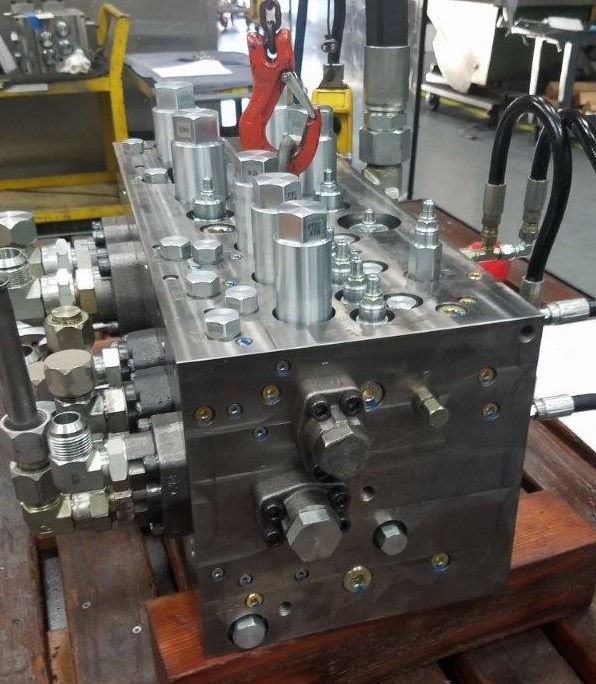
A custom manifold consolidates multiple valves and their interconnections into a single machined aluminum or steel block with internal passages. What might have been 30-50 external hose connections becomes 6-10 inlet/outlet ports on the manifold.
Reduction in leak points: 70-85% fewer external connections
Impact on maintenance: Fewer leak points means fewer o-ring failures, fewer hose failures, and dramatically reduced fluid loss
Impact on contamination: Fewer openings for dirt and moisture to enter the system
TCO calculation example:
Conventional system:
- 40 hose connections @ 2% annual failure rate = 0.8 hose failures/year
- Average repair cost: $350 (parts + 2 hours labor @ $100/hr)
- Annual hose failure cost: $280
Custom manifold system:
- 8 external connections @ 2% annual failure rate = 0.16 failures/year
- Annual hose failure cost: $56
- Annual savings: $224 per machine
Over a 10-year equipment life, that’s $2,240 in avoided hose replacement costs alone—and this doesn’t account for the reduced contamination-related component failures or the productivity losses from unplanned downtime.
2. Minimized Vibration-Related Failures
Mobile equipment operates in harsh environments with constant vibration. In conventional systems, vibration causes:
- Fittings to loosen and leak
- Hoses to rub against structures or each other, causing abrasion
- Valve mounting bolts to work loose
- Metal fatigue in tubing
Custom manifolds address vibration in multiple ways:
Solid mounting: The entire manifold assembly mounts to the machine frame with substantial fasteners, creating a rigid, vibration-resistant platform
Internal passages: Fluid passages are internal to the manifold block—no external hoses to vibrate and flex
Reduced hose lengths: The few remaining external hoses can be shorter and more direct, with less opportunity for vibration-induced wear
Integrated mounting: Valves are captured within the manifold or secured with heavy retaining hardware that resists vibration loosening
Real-world impact: Agricultural equipment manufacturers report that switching from conventional plumbing to custom manifolds reduced vibration-related hydraulic failures by 60-75%, particularly important in equipment operating 1,000+ hours annually in demanding field conditions.
3. Simplified and Faster Maintenance
When maintenance is required on a custom manifold system, the process is substantially simpler:
Valve replacement: Most custom manifolds use cartridge valves that can be replaced without draining the entire system. Remove the retaining hardware, pull the old cartridge, insert the new one, and reinstall the retainer. Total time: 15-30 minutes vs. 2-4 hours for conventional valve replacement.
Predictable component locations: With valves integrated into a manifold, technicians always know exactly where each function is located. No tracing hoses through the machine trying to find the problematic component.
Reduced system contamination during service: Because cartridge valves can often be changed without draining oil, there’s less exposure to contamination during maintenance and less wasted hydraulic fluid.
Less specialized training required: Manifold service follows standardized procedures: remove retainer, replace cartridge, reinstall retainer. Conventional systems require knowledge of different valve types, proper torque specifications for various fittings, and correct hose routing.
TCO impact:
Assuming an average maintenance event cost of:
- Conventional system: 3.5 hours labor @ $100/hr = $350
- Manifold system: 0.75 hours labor @ $100/hr = $75
- Savings per maintenance event: $275
If hydraulic maintenance occurs 3-4 times annually, that’s $825-1,100 in annual labor savings alone.
4. Extended Component Life Through Optimized Flow Paths
Custom manifolds are engineered specifically for the application, allowing designers to optimize internal flow passages for the actual operating conditions. This optimization delivers:
Minimized pressure drops: Properly sized passages and smooth flow transitions reduce unnecessary resistance, decreasing pump load and heat generation
Reduced flow turbulence: Gradual directional changes and elimination of sharp corners prevent turbulence that creates heat, noise, and component wear. Optimized flow paths also help prevent slow actuation issues that plague conventional systems.
Shorter flow paths: Internal manifold passages are typically much shorter than equivalent external hose routing, reducing pressure drop and improving response time
Better thermal management: Compact manifold design allows heat to dissipate through the larger thermal mass of the manifold block, and manifolds can be designed with integrated cooling passages
The result: pumps, motors, and actuators operate more efficiently with less heat stress, directly extending component life.
Industry data: Equipment operating with optimized custom manifolds typically sees hydraulic fluid operating temperatures 10-20°F lower than equivalent conventional systems. Since every 18°F increase in operating temperature halves hydraulic fluid life and accelerates seal degradation, this temperature reduction substantially extends fluid and component service intervals.
Cost impact: If a machine requires hydraulic fluid change every 1,000 hours with conventional plumbing but can go 1,500 hours with an optimized manifold:
- Fluid cost: $400 per change
- Labor cost: $150 per change
- Annual savings (assuming 2,000 operating hours): One fluid change = $550
5. Reduced Installation Time and Complexity
For OEM manufacturers, custom manifolds dramatically reduce production assembly time:
Pre-assembled and tested: Custom manifolds arrive at the assembly line fully populated with valves, pre-tested, and ready to install as a single unit
Simplified plumbing: Instead of routing dozens of individual hoses, assembly technicians make a handful of connections to manifold ports
Elimination of measurement and cutting: No field-measuring and cutting hoses to length—hoses from manifold to cylinders/motors are predetermined lengths
Reduced quality control points: One manifold assembly to inspect vs. 20-30 individual valve installations
Manufacturing efficiency impact:
A skid steer loader manufacturer reported the following assembly time comparison:
- Conventional hydraulic system assembly: 6.5 hours per machine
- Custom manifold system assembly: 1.5 hours per machine
- Time savings: 5 hours per machine
At a loaded labor rate of $50/hour, that’s $250 per machine in direct labor savings. For an OEM producing 500 units annually, this represents $125,000 in annual labor savings, a significant TCO benefit that flows directly to equipment buyers through more competitive pricing.
6. Superior Reliability and Reduced Unplanned Downtime
Every hour of unplanned downtime costs money in lost productivity, missed deadlines, and sometimes in contractual penalties. Custom manifolds reduce unplanned downtime through:
Proven designs: Well-engineered custom manifolds undergo extensive testing during development, including pressure testing, flow testing, and often thousands of hours of durability testing
Fewer failure modes: With 70-85% fewer connections, there are simply fewer things that can go wrong
Better contamination control: Sealed internal passages resist contamination far better than dozens of hoses and fittings exposed to the environment
Predictable maintenance: When components do eventually require service, it’s typically due to predictable wear rather than random failures of hoses or fittings
Downtime cost analysis:
Consider a large excavator operating in a mining environment:
- Operating cost: $250/hour (operator, fuel, overhead)
- Unplanned downtime with conventional system: 40 hours/year
- Unplanned downtime with custom manifold system: 10 hours/year
- Annual downtime cost savings: 30 hours × $250 = $7,500
Over the machine’s 15,000-hour service life (approximately 7-8 years of operation), this represents more than $50,000 in avoided downtime costs.
7. Improved Resale Value and Equipment Longevity
When equipment reaches the end of its primary service life, resale value becomes a critical component of TCO. Custom manifolds contribute to higher resale value through:
Better appearance: Clean, integrated manifold systems present better than older equipment with deteriorated hoses, stained fittings, and visible makeshift repairs
Documented reliability: Equipment with custom manifolds typically has better maintenance records—fewer emergency repairs and more predictable service histories
Updated technology: Custom manifolds can incorporate modern valve technology (proportional valves, electronic controls) that makes equipment more attractive to buyers
Lower hours to failure ratio: Buyers evaluate not just total hours, but condition relative to hours. Equipment showing minimal hydraulic issues at 8,000 hours commands premium pricing.
Easier refurbishment: If the owner chooses to refurbish before resale, manifold-based systems are simpler to restore to like-new condition
Resale value impact:
Industry data suggests well-maintained equipment with custom hydraulic manifolds retains approximately 5-8% higher resale value compared to equivalent machines with conventional hydraulic systems, controlling for hours and condition.
For a $250,000 excavator at 8,000 hours:
- Conventional system resale value: $125,000 (50% retention)
- Manifold system resale value: $133,750 (53.5% retention)
- Resale value benefit: $8,750
8. Space and Weight Optimization
While not always counted in traditional TCO calculations, space and weight optimization deliver real financial benefits:
Compact packaging: Custom manifolds occupy 40-60% less space than equivalent conventional valve arrays, freeing valuable space for other components or allowing more compact machine envelopes
Weight reduction: Aluminum manifolds replacing steel valves, brackets, and heavy hoses can save 50-100+ pounds on mid-size mobile equipment
Fuel savings: Every 100 pounds of weight reduction improves fuel economy by approximately 1-2% in mobile equipment
Better machine balance: Centralized manifold placement improves machine center of gravity and stability
Cost impact:
For equipment consuming 5 gallons of fuel per hour:
- Annual fuel consumption (2,000 hours): 10,000 gallons
- Fuel cost: $3.50/gallon = $35,000 annually
- 1% fuel savings from weight reduction: $350/year
- Ten-year fuel savings: $3,500
Custom Manifold TCO: A Case Study
To illustrate the cumulative TCO impact, consider this hypothetical case from an agricultural equipment manufacturer:
Equipment: Self-propelled agricultural sprayer Annual operating hours: 800 hours Expected service life: 12,000 hours (15 years)
Conventional Hydraulic System Costs (15-year TCO):
Maintenance:
- Annual hose replacements: $3,200
- Fitting repairs and replacements: $800
- Valve rebuilds/replacements: $1,500
- Additional contamination-related failures: $2,000
- Total annual maintenance: $7,500
- 15-year maintenance total: $112,500
Downtime:
- Unplanned hydraulic failures: 30 hours/year
- Cost per hour of downtime: $400 (lost coverage area + operator cost)
- Annual downtime cost: $12,000
- 15-year downtime total: $180,000
Hydraulic fluid (extra changes due to contamination):
- 2 additional fluid changes over 15 years
- Cost: $1,200
Reduced resale value:
- $12,000 lower than manifold-equipped unit
15-Year Total TCO Impact (conventional): $305,700
Custom Manifold System Costs (15-year TCO):
Initial manifold premium over conventional: $8,500
Maintenance:
- Annual hose replacements: $800
- Fitting repairs: $200
- Valve cartridge replacements: $900
- Contamination-related failures: $500
- Total annual maintenance: $2,400
- 15-year maintenance total: $36,000
Downtime:
- Unplanned hydraulic failures: 8 hours/year
- Cost per hour: $400
- Annual downtime cost: $3,200
- 15-year downtime total: $48,000
Hydraulic fluid:
- Minimal extra fluid changes
- Cost: $0
Improved resale value:
- $12,000 premium
15-Year Total TCO Impact (manifold): $84,000 (including initial $8,500 premium)
Net TCO Advantage: $221,700 over 15 years
The $8,500 initial investment in a custom manifold returned more than 26:1 in total cost savings—a compelling financial case that becomes even stronger when considering the intangible benefits of improved reliability, easier maintenance, and better operator experience.
When Custom Manifolds Make the Most Sense
While custom manifolds offer substantial TCO benefits across many applications, they deliver maximum value in these scenarios:
High-Utilization Equipment
Equipment operating 1,500+ hours annually accumulates wear rapidly. The reliability and reduced maintenance of custom manifolds pays back quickly when machines are worked hard.
Production Equipment (OEM Manufacturing)
For manufacturers producing multiple units of the same machine, the initial engineering investment in custom manifold design amortizes across production volume. Once designed and tested, manifolds can be manufactured repeatedly at competitive costs while delivering assembly efficiency and product differentiation.
Mission-Critical Applications
When downtime creates severe financial consequences—contract penalties, lost production, stranded crews—the reliability of custom manifolds justifies premium pricing.
Harsh Operating Environments
Equipment operating in extreme vibration, temperature fluctuations, contamination exposure, or corrosive atmospheres benefits tremendously from the sealed, integrated design of custom manifolds.
Space-Constrained Machinery
Compact equipment (skid steers, compact excavators, agricultural implements) benefits from manifolds’ space efficiency. The same applies to equipment where accessibility for maintenance is limited. Lift truck attachment manifolds are excellent examples of how custom manifolds solve space challenges in material handling applications.
Equipment with Complex Hydraulic Requirements
Machines requiring 8+ hydraulic functions, sequencing operations, load-sensing systems, or integrated electronic controls benefit from custom manifolds that can elegantly manage complexity. Pressure reducing manifolds and soft-shift directional valve manifolds demonstrate how specialized manifold designs address sophisticated control requirements.
Evaluating Custom Manifolds vs. Conventional Systems: A TCO Framework
When making purchasing decisions or designing equipment, evaluate the TCO of custom manifolds using this framework:
Step 1: Calculate Baseline TCO for Conventional System
- Initial system cost
- Annual maintenance costs (hoses, fittings, valves)
- Expected unplanned downtime hours × cost per hour
- Additional fluid changes from contamination
- Impact on resale value
Step 2: Calculate TCO for Custom Manifold System
- Initial manifold premium
- Reduced annual maintenance costs
- Reduced downtime hours × cost per hour
- Fluid savings
- Improved resale value
Step 3: Calculate Payback Period
(Manifold premium) ÷ (Annual savings from reduced maintenance + reduced downtime) = Payback period in years
If payback period is less than 25-30% of expected equipment life, custom manifolds typically represent excellent value.
Step 4: Consider Intangible Benefits
- Simplified technician training
- Reduced spare parts inventory
- Improved operator satisfaction
- Competitive differentiation (for OEMs)
- Regulatory compliance (sealed systems reduce environmental exposure to leaks)
The Engineering Investment: Why Custom Manifolds Aren’t “One Size Fits All”
It’s important to understand that “custom” manifolds deliver TCO benefits precisely because they’re engineered for specific applications. This engineering investment includes:
Application analysis: Understanding operating pressures, flow requirements, cycle times, and environmental conditions
Circuit design: Creating optimized hydraulic circuits with proper valve selection and flow path design
CAD modeling: 3D modeling of the manifold block, internal passages, port locations, and valve cavities using specialized software (AutoCAD, Inventor, MDTools)
Flow simulation: Computational fluid dynamics (CFD) analysis to optimize passage sizing and minimize pressure drops
Thermal analysis: Ensuring adequate heat dissipation for the operating conditions
Prototyping and testing: Physical prototypes tested to verify pressure ratings, flow performance, and durability
Manufacturing process development: CNC programming, machining procedures, cleaning protocols, and quality control procedures
This engineering work represents an upfront investment—typically $5,000 to $25,000 depending on complexity—that’s justified by production volume and TCO benefits. For OEMs, this cost amortizes across production runs. For individual end-users with unique applications, the engineering cost must be weighed against operational savings.
Working with a Custom Manifold Partner: What to Expect
When engaging a hydraulic manifold manufacturer for custom design work, the process typically follows these stages:
1. Application Assessment
Your manifold partner will need to understand:
- Complete machine specifications and operating parameters
- Hydraulic circuit requirements and functions
- Space constraints and mounting requirements
- Operating environment conditions
- Expected production volume or quantity needed
- Timeline requirements
2. Concept Design and Quotation
The manufacturer develops:
- Preliminary manifold configuration
- Valve selection and placement
- Approximate dimensions and weight
- Cost estimate for engineering, prototypes, and production units
3. Detailed Engineering
If the project proceeds:
- Complete 3D CAD models
- Internal flow path optimization
- Port and mounting design finalized
- Electrical integration (if applicable)
- Manufacturing drawings and specifications
4. Prototype Manufacturing and Testing
- CNC machining of manifold block
- Valve and component assembly
- Pressure testing (as required)
- Flow testing (as required)
- Functional testing on machine (if possible)
- Design refinements based on test results
5. Production Approval and Manufacturing
- Final design approval
- Production tooling setup
- Quality control procedures established
- Initial production run
- Ongoing production as needed
Material Selection: Aluminum vs. Steel Manifolds
Material choice impacts both initial cost and long-term TCO:
Aluminum Manifolds
Advantages:
- Lighter weight (30-40% lighter than steel)
- Excellent thermal conductivity (helps dissipate heat)
- Easier to machine (lower manufacturing cost)
- Adequate strength for most mobile equipment (up to 5,000 PSI)
- Better corrosion resistance in many environments
Best for: Mobile equipment where weight matters, systems under 5,000 PSI, applications requiring good heat dissipation
Steel Manifolds
Advantages:
- Higher strength (suitable for 6,000+ PSI systems)
- Greater durability in high-cycle applications
- Better wear resistance at valve interfaces
- Preferred for industrial stationary applications
Best for: High-pressure systems, extreme-duty applications, stationary equipment where weight is less critical
Stainless Steel Manifolds
Advantages:
- Maximum corrosion resistance
- Suitable for food processing, marine, chemical applications
- Long service life in harsh environments
Trade-offs: Higher material and machining costs
Best for: Marine equipment, food processing, chemical handling, any application where corrosion is a primary concern
For most mobile equipment applications, aluminum manifolds offer the best TCO balance—lower initial cost, weight savings that improve fuel economy, and excellent heat dissipation that extends component life.
The Compelling TCO Case for Custom Manifolds
The financial case for custom hydraulic manifolds in mobile equipment is clear and compelling. While initial costs may exceed conventional hydraulic plumbing by $5,000-15,000, the long-term TCO advantages typically deliver returns of 10:1 to 30:1 over the equipment’s service life through:
- 70-85% reduction in hydraulic connection points and associated failures
- 60-80% reduction in hydraulic maintenance labor
- 60-75% reduction in unplanned downtime from hydraulic failures
- Extended component life from optimized flow paths and reduced contamination
- Improved fuel economy from weight reduction
- Enhanced resale value from better appearance and reliability records
For OEM manufacturers, custom manifolds deliver additional value through:
- Reduced assembly time and labor costs
- Product differentiation and competitive advantage
- Simplified spare parts support
- Ability to update/improve designs across production runs
For equipment owners and fleet managers, custom manifolds mean:
- More predictable maintenance schedules and costs
- Reduced emergency repair expenses
- Higher equipment availability and utilization
- Better operator satisfaction from more reliable equipment
The question isn’t whether custom manifolds reduce TCO—the data overwhelmingly demonstrates they do. The question is whether your specific application justifies the engineering investment required to create a truly optimized manifold solution. For production equipment, high-utilization machines, and mission-critical applications, that answer is almost always yes.
Partner with Hydra Power Systems for Custom Manifold Solutions
Since 1970, Hydra Power Systems has been designing and manufacturing custom hydraulic manifolds for mobile and industrial equipment across agriculture, construction, marine, material handling, and specialty applications. Our in-house engineering team combines deep application knowledge with advanced design capabilities to create manifold solutions that deliver measurable TCO improvements.
Whether you’re an OEM looking to improve your next equipment design or a fleet manager seeking to upgrade existing equipment for better reliability, Hydra Power Systems can help you achieve lower TCO through optimized custom manifold solutions.