
Mobile equipment engineers face a familiar tension: machines are getting smarter, but hydraulic control systems haven’t always kept pace. Electronic machine controllers have become standard on excavators, telehandlers, agricultural sprayers, and loader cranes.
Yet for many OEMs, connecting those machine-level controllers to the hydraulic valve bank still means running a separate cable to every solenoid, adding discrete amplifier cards, and managing all the commissioning complexity that comes with it. The result is wiring harnesses that grow heavier with each new function, control cabinets that eat up space, and integration work that adds weeks to production cycles.
HAWE Hydraulik’s PSL series proportional directional spool valve, combined with integrated CAN bus onboard electronics, changes that equation. Rather than treating the valve as a passive component that waits for analog signal inputs, the PSL CAN puts intelligent control directly on the valve bank itself — reducing external wiring to a single CAN connection, enabling precise electronic flow management, and opening a path toward machine automation that doesn’t require a complete hydraulic redesign.
As an authorized HAWE Hydraulik distributor for the Southeast region, Hydra Power Systems offers access to the full PSL CAN product family, backed by in-house engineering support to help OEMs and industrial customers select, specify, and integrate these valves into real applications. This post covers the technical fundamentals of the PSL platform, explains both the full CAN and CAN Lite actuation options, walks through the key operational advantages, and addresses the application scenarios where PSL CAN technology delivers the strongest return.
What the HAWE PSL Series Is and Why It Matters for Mobile Equipment
Before exploring the CAN integration in depth, it helps to understand the PSL valve’s position in the broader hydraulic landscape and why it’s particularly well-suited to mobile machinery.
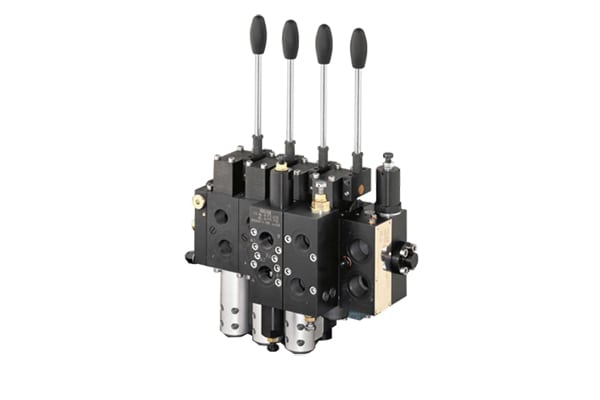
The PSL is a proportional directional spool valve. Unlike on/off solenoid-operated valves that simply open or close a flow path, proportional valves modulate the position of the internal spool continuously in response to a command signal. The spool’s position governs how much flow passes through the valve and in which direction, which means the downstream actuator — cylinder, motor, or otherwise — can be moved at precisely controlled speeds and through metered transitions. For mobile equipment, where smooth boom extension, gradual load lowering, and coordinated multi-function operation define the operator experience, proportional control is not a luxury. It’s a core requirement.
HAWE designs the PSL for demanding mobile conditions. The valves are built for robustness in harsh environments: vibration, temperature cycling, contaminated hydraulic circuits, and mounting orientations that would challenge less rugged designs. HAWE’s engineering philosophy centers on high power density, delivering high flow rates and pressure ratings within a compact envelope, which fits naturally with the space constraints found on mobile platforms. Valve banks consisting of multiple PSL sections can be stacked into a single assembly with common pressure and tank connections, reducing plumbing complexity compared to individual valve configurations.
The PSL is available in multiple size classes to accommodate different flow ranges, and spool configurations can be specified for float, regenerative, and other specialized circuit requirements. This configurability means a single valve family can serve a wide range of functions across the same machine or across different products in an OEM’s lineup, simplifying the supplier relationship and reducing the number of distinct components to stock and support.
Understanding CAN Bus in the Mobile Hydraulics Context
CAN bus (Controller Area Network) is the communication backbone of virtually every modern mobile machine. Developed originally for automotive applications and standardized under ISO 11898, CAN has become the dominant serial communication protocol in off-highway equipment because of its noise immunity, deterministic real-time behavior, and ability to connect dozens of nodes on a two-wire bus without the signal degradation that plagues long analog cable runs.
On a typical mobile machine, the engine control unit, transmission controller, joystick and input devices, display and human-machine interface, and increasingly the hydraulic control system all communicate via CAN. The protocol defines how each node broadcasts data and how messages are prioritized, so that a critical safety message from a load-sensing circuit always gets through even when less urgent sensor data is also on the bus.
For hydraulic control specifically, CAN enables a fundamentally different architecture compared to traditional analog actuation. In a conventional proportional valve setup, the machine controller outputs a 4–20 mA or ±10 V analog signal per valve section. Each signal travels on its own dedicated wire from the control cabinet to the valve solenoid, often passing through an external amplifier card that conditions the signal and drives the solenoid with the appropriate current. In a multi-section valve bank, which is common on loaders, cranes, and agricultural equipment with six, eight, or more simultaneous functions, the wiring bundle can be substantial, and any fault in a single cable or connector means that function goes down.
CAN-based hydraulic actuation collapses all of that into two wires. A single twisted pair runs from the machine controller to the valve bank (along with power supply lines), and each valve section’s onboard electronics receive their commands as digital CAN messages. The advantages accumulate quickly: less wire means less weight, fewer potential failure points, easier troubleshooting with a CAN diagnostic tool, and a much cleaner wiring layout that reduces manufacturing labor and field service time.
The HAWE PSL CAN takes this architecture and makes it accessible to OEMs that don’t need to develop the full CAN node electronics in-house, because HAWE has already built it directly into the valve actuation package.
The PSL CAN Product Family: Full CAN and CAN Lite
HAWE offers two distinct CAN actuation configurations for the PSL platform, each optimized for different levels of application precision and budget:
PSL with Full CAN Actuation
The full CAN actuation option provides comprehensive onboard electronics with closed-loop spool position feedback. A built-in position sensor continuously monitors the actual spool displacement and feeds that data back to the onboard controller, which then adjusts solenoid current to maintain the commanded position. This closed-loop approach compensates for spool hysteresis, pressure differential effects on spool position, and temperature-related changes in solenoid resistance — all the sources of inaccuracy that affect open-loop proportional systems.
The practical result is significantly improved repeatability and linearity in the valve’s flow characteristic. For applications where an operator or automated system needs the actuator to move at a precise, predictable speed regardless of load pressure variations or ambient conditions — think a crane positioning a load, or a spray boom maintaining consistent application width across varying terrain — closed-loop spool position control makes a meaningful difference in the quality of the output.
The full CAN version communicates its spool position feedback data back onto the CAN bus, making that information available to other nodes on the network. A machine controller can monitor actual valve response, compare it to commanded position, and make compensating adjustments at the system level. This bidirectional communication supports condition monitoring, predictive maintenance strategies, and the development of more sophisticated automated control loops.
Parameters including spool end position limits, ramp times for opening and closing transitions, maximum flow limits per section, and CAN identifier addresses are configurable through HAWE’s PSXCAN software tool, which is available as a free download. Parameters are stored in the valve’s onboard memory and take effect immediately, so commissioning and tuning can be done at the valve without modifying the machine controller’s software.
PSL CAN Lite
The CAN Lite actuation is HAWE’s cost-optimized entry point into CAN-based hydraulic control. It retains the CAN bus communication interface and the onboard electronics for receiving digital commands, processing ramp and scaling parameters, and driving the proportional solenoid with accurate current control — but it does not include closed-loop spool position feedback. Spool position is controlled in an open-loop manner based on the commanded signal and the pre-set parameter map.
For many mobile applications, this is entirely sufficient. The improvement in control quality over conventional analog actuation is still substantial, and the wiring simplification and CAN integration benefits are identical to those of the full CAN version. OEMs that need precise, repeatable metering can achieve it with CAN Lite by mapping the valve’s flow curve carefully during commissioning and ensuring their system pressure and supply conditions are consistent — which is standard practice for well-designed mobile circuits anyway.
HAWE configures key parameters — spool start and end positions, CAN bus communication settings including address and baud rate — prior to delivery, according to the customer’s specifications. This means the valve arrives pre-configured for the specific application, reducing commissioning time to connection, power-up, and functional verification rather than a full parameter setup session. Additional adjustments can be made in the field with the PSXCAN tool, and HAWE provides firmware updates through the same platform.
The CAN Lite actuation exhibits very low hysteresis by proportional spool valve standards, which is notable because hysteresis — the tendency of the valve to behave slightly differently when the command is increasing versus decreasing — is one of the primary control quality metrics for proportional valves. Low hysteresis means the operator or control system can reliably place the valve’s flow at a target value from either direction of approach, which is particularly important for functions like load holding and smooth directional reversals.
Combining Full CAN and CAN Lite in a Single Valve Bank
One of the more elegant aspects of the PSL CAN platform is that both actuation types can be mixed within a single multi-section valve bank. An OEM can specify full CAN actuation with spool position feedback on the sections that require the highest precision — a main lift function on a loader crane, for example, or a tilting function on an aerial work platform — while using CAN Lite actuation on auxiliary functions where open-loop control is sufficient. Each section still communicates on the same CAN bus and receives commands from the same machine controller. The result is optimal allocation of hardware cost and performance, with no compromises on integration simplicity.
Electronic Flow Sharing: Managing Flow Under Pump Undersupply Conditions
One of the more consequential capabilities of PSL CAN onboard electronics — available in both the full CAN and CAN Lite versions — is Electronic Flow Sharing (EFS). To understand why this matters, it helps to understand the problem it solves.
On a mobile machine with a fixed-displacement pump or a variable-displacement pump operating at its delivery limit, simultaneously commanding multiple high-demand functions can result in the pump being unable to supply the total requested flow. In a conventional hydraulic system without flow sharing, this condition causes the path of least resistance to receive disproportionate flow — typically meaning the function with the lightest load pressure accelerates while the function with the heavier load slows or stops. The operator experiences this as a loss of simultaneous control: extending the boom and opening the grapple at the same time produces unpredictable combined motion.
Load-sensing systems mitigate this in the hydraulic domain by biasing pump output to the highest load pressure in the system, which ensures all active functions see proportional flow reduction when the pump is undersupplied rather than one function starving another. Electronic Flow Sharing in the PSL CAN achieves a similar outcome through the onboard electronics without requiring a full load-sensing hydraulic circuit. When the system detects a supply undersupply condition, each active valve section reduces its commanded flow proportionally, maintaining the relative speeds of all simultaneously active functions while staying within the available supply. This gives the operator predictable multi-function behavior even when the machine is working at full capacity.
EFS also enables function prioritization: critical functions such as steering, emergency braking, or primary lift can be assigned higher priority in the EFS logic, ensuring they receive adequate flow before lower-priority secondary functions are served. This is a particularly valuable capability for safety-critical machine architectures where hydraulic function hierarchy needs to be enforced electronically rather than purely through circuit design.
Wiring Simplification: From Harness Complexity to a Single Bus Connection
The wiring benefits of PSL CAN deserve a dedicated discussion because they represent a genuine step-change in how mobile hydraulic systems are assembled and maintained, not just an incremental improvement.
In a conventional analog proportional valve installation on a machine with, for example, eight valve sections, the electrical connection between the control system and the valve bank involves sixteen solenoid connections (two per section, for the A and B sides), plus any fault detection feedback signals. These connections run through the machine’s wiring harness to an electronics enclosure containing the amplifier cards that drive each solenoid. The harness itself is routed through the machine frame, often passing through bulkhead fittings and around other mechanical systems. At each connector and splice point is a potential failure location: corrosion, chafing, connector seating issues, and moisture intrusion are among the most common causes of intermittent valve faults in the field.
The PSL CAN replaces all of those individual solenoid connection wires with a single CAN bus connection (the two-wire CAN H/CAN L twisted pair) plus a power supply to the valve bank electronics. Adding more valve sections doesn’t add proportionally more wiring — the bus architecture means each additional section is simply another node on the same two wires. The total wire count reduction going from eight sections of analog actuation to eight sections of CAN actuation can be dramatic, and the connector count reduction follows accordingly.
For OEM production operations, this changes the assembly workflow. Rather than running and connecting sixteen individual solenoid leads, assemblers connect one CAN plug and one power connector to the valve bank. Harness routing is simpler, the final harness is lighter and more compact, and the risk of wiring errors during assembly is substantially reduced. In production environments where labor efficiency and first-pass quality rates are tracked carefully — as they are in most OEM plants building equipment in the tens to hundreds of units per year — these improvements compound into meaningful cost savings over a model’s production lifecycle.
Field service benefits are equally significant. A technician diagnosing a valve control issue can connect a CAN analyzer to the bus and observe actual command and feedback traffic in real time, rather than probing analog signal levels at individual connectors. HAWE’s PSXCAN tool provides a guided diagnostic interface specifically for the PSL CAN, including real-time parameter monitoring, fault code readout, and step-by-step repair guidance. This reduces diagnostic time and the specialized electrical troubleshooting knowledge required of field technicians, which is particularly relevant for equipment distributed into markets where fully trained hydraulic technicians are not always accessible.
Hazardous Area Certifications
For OEMs building equipment for operation in classified hazardous areas — oil and gas processing facilities, mining environments with explosive atmospheres, chemical processing plants — the PSL CAN (and its sibling PSV variant) carries certifications for use in explosion-prone zones. These certifications cover relevant standards in the EU, China, and the United States, making the same valve platform usable across globally deployed equipment without requiring a different hardware solution for different regional regulatory environments.
This is not a minor detail for OEMs serving these markets. Certifying hydraulic components for hazardous area use is a time-consuming and expensive process; having a high-performance proportional valve with onboard CAN electronics that already carries the necessary approvals removes a significant development barrier for equipment intended for upstream oil and gas, mining extraction, or similar applications.
Application Scenarios Where PSL CAN Technology Excels
The HAWE PSL CAN platform is broadly applicable across mobile equipment categories, but certain application characteristics make it a particularly strong fit.
Multi-Function Mobile Equipment with High Channel Count
Loader cranes, telescopic handlers, knuckle boom trucks, and forestry harvesters all share the characteristic of having numerous simultaneously operable hydraulic functions. When a machine needs ten or twelve proportional control channels, the wiring and amplifier infrastructure required for conventional analog actuation becomes genuinely burdensome. PSL CAN’s single-bus architecture scales gracefully to high channel counts, and the ability to mix full CAN and CAN Lite sections means each channel gets the level of control electronics it actually needs.
OEM Platforms Targeting Machine Automation
Precision agriculture, automated material handling, and robotically controlled specialty machines are increasingly designed around closed-loop machine control architectures where the hydraulic subsystem must respond accurately to electronic commands generated by GPS systems, vision sensors, or mission-planning software rather than directly by a human operator.
In these applications, the bidirectional communication capability of PSL CAN’s full actuation — sending commands and receiving spool position feedback on the same bus — is architecturally essential. The machine controller can close the loop around actual hydraulic behavior, not just commanded behavior, enabling the levels of accuracy that precision automation requires.
Electrification-Ready Mobile Machine Platforms
Battery-electric and hybrid-electric mobile machines present new constraints and opportunities for hydraulic system design. Electric drivetrains change the power management equation: regenerative braking, variable-speed electric pump drives, and tighter energy budgets make intelligent hydraulic flow management more important than ever.
PSL CAN’s Electronic Flow Sharing, fine-control range limiting, and ramp management capabilities fit naturally into electrified architectures where every liter of hydraulic flow represents energy drawn from the battery. OEMs developing next-generation electric work machines benefit from a valve platform that supports the integrated electronic control strategies these machines require.
Construction and Infrastructure Equipment
Excavators, compact track loaders, mini cranes, and utility diggers operate in environments where wiring durability is a constant concern. Mud, vibration, water ingress, and physical abuse from jobsite conditions are routine. PSL CAN’s simplified wiring architecture — fewer connectors, fewer cables — directly reduces exposure to the failure modes that most commonly disable hydraulic control systems in these environments. Construction equipment OEMs building for total cost of ownership as a competitive differentiator will find the field reliability implications of reduced wiring complexity worth quantifying in their product value propositions.
Agricultural Machinery
Field sprayers, self-propelled forage harvesters, and precision seeders operate with hydraulic functions that must integrate tightly with GPS-guided control systems, section control logic, and telematics platforms. CAN bus connectivity is already the standard communication fabric on these machines. PSL CAN’s native CAN integration makes it a natural component for agricultural OEMs that want proportional hydraulic control as part of a fully connected, software-managed machine platform. The low hysteresis characteristics of the CAN Lite option are well-suited to spray boom positioning and implement lift functions where smooth, predictable response to GPS rate-based or section-control commands translates directly to field performance.
Commissioning and Configuration with the PSXCAN Tool
HAWE provides the PSXCAN software tool as a free download, along with firmware updates, for the PSL CAN product family. The tool connects to the valve bank via a CAN-USB adapter and provides a graphical interface for viewing and adjusting all configurable parameters.
Key configurable parameters include:
Spool position limits — The start position (the minimum spool displacement at which flow begins) and end position (the maximum spool displacement corresponding to the commanded full-flow signal) can be set independently for each direction of travel. Adjusting these parameters allows the valve’s effective flow range to be matched to the downstream actuator’s speed requirements without modifying the machine controller’s output mapping.
Ramp times — The rate at which the valve opens and closes in response to step changes in command signals is configurable independently for each direction. Ramp control smooths transitions and prevents shock loading in systems where the machine’s control input changes quickly.
Flow limiting — Maximum flow through each section can be electronically limited, independent of the pressure differential and pump supply. This is useful for secondary functions that should not be allowed to consume more than a defined share of pump capacity, or for functions where speed limiting is a safety requirement.
CAN address and baud rate — Each section’s CAN node address and the bus baud rate are configurable, allowing the valve bank to be integrated into the specific CAN network architecture of the machine without hardware changes.
Electronic Flow Sharing parameters — EFS behavior, including priority assignments and the trigger conditions for proportional flow reduction, can be tuned to match the machine’s specific functional priority hierarchy.
HAWE pre-configures parameters to customer specifications prior to delivery, so for OEMs running production builds, the valve arrives ready to install without requiring technicians to run the configuration software on every unit. For development work and prototype validation, the PSXCAN tool’s real-time monitoring capabilities — including live spool position display for full CAN versions, current feedback, and fault status — provide visibility into valve behavior that significantly accelerates calibration and troubleshooting.
How Hydra Power Systems Supports HAWE PSL CAN Integration
Hydra Power Systems has been serving OEMs and industrial customers with hydraulic and fluid power solutions since 1970, with locations in Portland, Oregon, and Birmingham, Alabama. The recent partnership with HAWE Hydraulik USA establishes Hydra Power Systems as an authorized HAWE distributor for the Southeast region, covering Alabama, Georgia, Mississippi, and Tennessee — with Portland extending coverage to customers in the Pacific Northwest.
What this partnership means practically is that customers in these regions gain direct access to HAWE’s PSL CAN valve family through a distributor with deep application engineering capability. Hydra Power Systems doesn’t just stock and ship components. The team includes in-house engineers who work through circuit design, manifold block integration, system sizing, and application-specific configuration questions with customers from concept through production. For OEMs evaluating whether PSL CAN is the right technology for a new machine development program — or for customers looking to upgrade existing machines from analog actuation to CAN-based control — this engineering support layer makes a substantive difference in how quickly and successfully the integration proceeds.
Hydra Power Systems also designs and manufactures custom hydraulic manifolds that can be built around HAWE PSL CAN valve banks. Integrating the valve bank into a custom manifold block that includes pressure relief, load-holding, and circuit protection functions in a single machined assembly reduces plumbing complexity, eliminates potential leak points, and produces a more compact, serviceable hydraulic circuit.
For OEMs building at production volumes — from dozens to several hundred units per year — this kind of integrated manifold-and-valve assembly represents a meaningful opportunity to reduce both BOM cost and assembly labor compared to building the same circuit from discrete components.
The Hydra Power Systems hydraulic components distribution operation maintains inventory at both warehouse locations for fast response to production and service requirements. Regional stocking means shorter lead times compared to relying on manufacturer-direct supply for standard configurations, which matters both for production scheduling and for field service situations where a replacement valve is needed quickly to return a machine to service.
Evaluating PSL CAN for Your Application: Key Decision Criteria
For engineering teams considering PSL CAN valves for a new or existing machine platform, the following criteria are the most useful starting points for a technical evaluation:
Control precision requirements. If the application demands closed-loop spool position feedback — because the machine’s control architecture closes an outer position or velocity loop around the hydraulic actuator — the full CAN actuation with spool position feedback is necessary. For applications where the machine controller manages command signals at the joystick or sensor-fusion level and the valve simply needs to respond accurately and consistently to those commands, CAN Lite is typically sufficient.
Channel count and wiring complexity. The more proportional control channels the machine requires, the greater the relative benefit of CAN bus actuation. At low channel counts (two to four sections), the wiring simplification is still real but less dramatic. At six sections and above, the case for CAN-based actuation grows substantially.
Function prioritization and simultaneous operation. If the machine operates multiple functions simultaneously and pump undersupply is a realistic operating condition — which it is on most mobile machines working at full load — Electronic Flow Sharing capability should be in the requirement set.
Hazardous area operation. If equipment will be deployed in classified explosive atmospheres, confirming that the required regional certifications are in scope early in the design process is essential.
Integration with existing machine CAN architecture. PSL CAN valves operate as standard CAN nodes and are compatible with any machine controller that can output CAN messages in the valve’s expected format. Reviewing the communication protocol documentation and confirming compatibility with the machine’s existing CAN stack is a straightforward step, but one worth completing early in the design process.
Production economics. The wiring and assembly labor savings from CAN actuation represent real cost reductions that scale with production volume. For OEMs building significant numbers of units per year, quantifying this savings against the per-valve cost differential between CAN and analog actuation typically yields a payback analysis that supports the investment in CAN-based architecture.
Summary
The HAWE PSL CAN platform represents a mature, thoroughly engineered solution to one of the persistent integration challenges in mobile hydraulics: how to connect intelligent machine electronics to the proportional valve bank in a way that is reliable, scalable, and cost-effective. The single-bus CAN connection, onboard parameter management, Electronic Flow Sharing, and hazardous area certifications address real requirements that OEMs across construction, agriculture, material handling, and specialty equipment face as their machine platforms become more sophisticated.
The availability of both full CAN and CAN Lite actuation options — and the ability to mix them within a single valve bank — means OEMs can apply the right level of electronic capability to each function rather than over-specifying the entire system. HAWE’s pre-delivery configuration service and free PSXCAN tool make commissioning straightforward, and the bidirectional communication of the full CAN version opens the door to condition monitoring and automated control strategies that would require separate sensing hardware in conventional systems.
Hydra Power Systems brings this technology to customers in the Southeast and Pacific Northwest with the application engineering depth, custom manifold manufacturing capability, and regional inventory support to help OEMs move from initial evaluation to production-ready integration efficiently. Whether the project is a new machine development program, an upgrade to an existing platform, or a field service improvement initiative, the combination of HAWE PSL CAN technology and Hydra Power Systems’ engineering support provides a strong foundation.
To discuss how PSL CAN technology might apply to your specific hydraulic control requirements, contact Hydra Power Systems at the Birmingham, AL or Portland, OR locations, or request an estimate directly online.