
Hydraulic drive motors are the component that turns pressurized fluid into rotating output, the torque and speed that actually move a machine, spin a winch, or drive a conveyor. For engineers specifying a new system or troubleshooting an underperforming one, understanding how these motors work, and which type fits a given application, is one of the more consequential decisions in the whole hydraulic circuit.
How a Hydraulic Drive Motor Works
A hydraulic drive motor converts flow and pressure into mechanical rotation. Pressurized fluid enters the motor and acts on internal pistons, gears, or vanes, generating torque proportional to system pressure and speed proportional to flow rate. The relationship is straightforward in principle: more pressure means more torque, more flow means more speed, but the way a given motor architecture achieves that conversion has a big effect on efficiency, durability, and how well the motor tolerates real-world operating conditions.
Displacement, measured in cubic inches or cc per revolution, describes how much fluid volume the motor consumes for each shaft rotation. Higher displacement motors produce more torque at a given pressure but turn more slowly for a given flow rate. Lower displacement motors spin faster but produce less torque per revolution. Matching displacement to the load and speed the application actually needs is the starting point for any motor selection.
Common Hydraulic Motor Types
Gear motors are simple, compact, and cost-effective, making them a common choice for lower-pressure, lower-torque applications where budget and packaging matter more than peak efficiency.
Vane motors offer a middle ground, with moderate efficiency and a design that tolerates some contamination, often used in applications with variable loads.
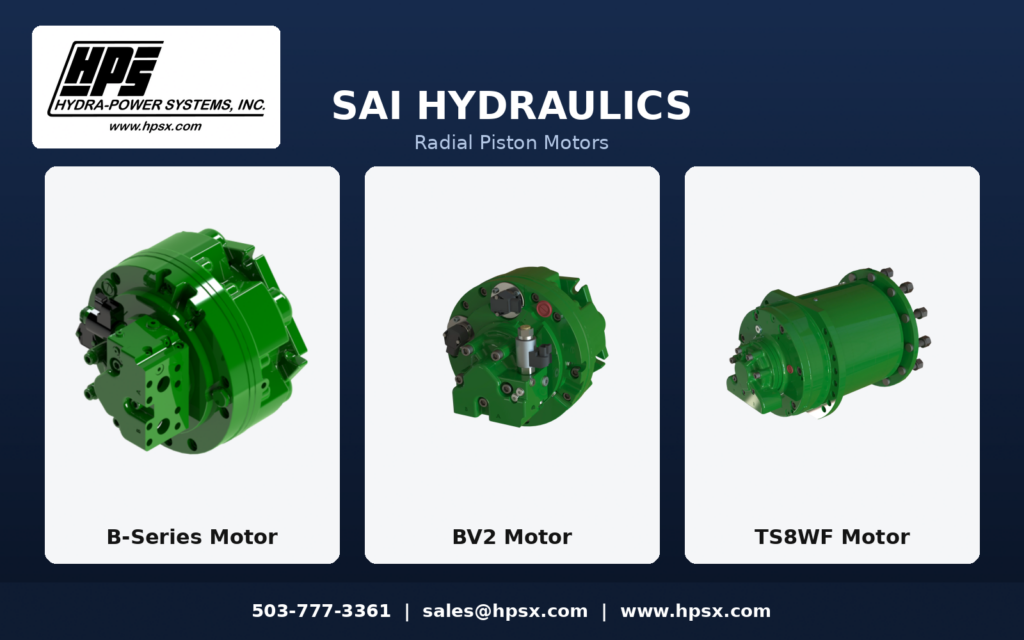
Radial piston motors use pistons arranged around a crankshaft to deliver high starting torque and strong volumetric efficiency, even at low speeds. This makes them well suited to demanding applications such as winches, augers, and propel drives, where the motor needs to start and hold a heavy load without stalling. Radial piston motors also tend to hold up well against contamination and thermal cycling, which matters in mobile equipment operating in dirty or variable-temperature environments.
Axial piston motors use pistons arranged parallel to the drive shaft and are typically favored where high speed and a compact envelope matter more than maximum low-speed torque.
Fixed vs. Variable Displacement
Fixed displacement motors deliver a constant torque-to-speed ratio for a given flow and pressure. They’re straightforward, reliable, and appropriate for applications with a consistent load and speed requirement.
Variable and dual displacement motors can shift their displacement, either between two fixed points or continuously, while the machine is running. This lets a single motor cover a wider operating range efficiently: high torque at low speed for starting or climbing a grade, then reduced displacement for higher speed once the load eases. For circuits with a wide operating range, a variable displacement motor often outperforms a fixed displacement motor sized as a compromise between the two extremes, since it avoids the efficiency losses that come with over- or under-sizing for one end of the range.
Key Selection Criteria
When specifying a hydraulic drive motor, a few factors typically drive the decision:
- Torque and speed requirements. Calculate the torque needed at the load and the speed range the application demands, then work backward to displacement and flow.
- Duty cycle. Continuous-duty applications place different demands on a motor than intermittent, high-torque starts.
- Operating environment. Contamination, temperature swings, and exposure to the elements all favor motor designs built for durability over raw efficiency.
- Control requirements. Applications with a wide operating range benefit from variable or dual displacement designs with hydraulic or electronic control.
- Serviceability. In mobile equipment, especially in the field, a motor with accessible, modular components can mean the difference between a quick repair and extended downtime.
Choosing a Hydraulic Drive Motor Partner
Selecting the right motor is only part of the equation. Working with a supplier who carries a broad enough range to match displacement, torque, and control requirements without compromise, and who can provide the technical guidance to size it correctly, makes the process considerably more straightforward.
Hydra-Power Systems stocks and distributes SAI Hydraulics’ full line of radial piston motors, including fixed displacement models and dual/variable displacement designs with integrated electronic control, along with SAI’s planetary gearboxes, wheel drives, and rotary manifolds. Whether the application calls for a compact fixed-displacement motor or a variable displacement unit built for a wide operating range, our team can help match the right component to the job. Learn more on our SAI Hydraulics product page.