
Mobile equipment already has a power source most operators aren’t fully using: the hydraulic system. A hydraulic-driven high-pressure water pump taps into that existing power to deliver pressurized water for street cleaning, dust suppression, demolition cleanup, and quarrying, without adding a separate engine, fuel tank, or maintenance schedule.
For fleet managers and equipment builders evaluating this kind of system, sizing the pump correctly is the difference between a unit that keeps up with the job and one that constantly runs short of flow or pressure.
How a Hydraulic-Driven Water Pump Works
Instead of running on its own gas or diesel engine, a hydraulic high-pressure water pump connects directly to a machine’s existing hydraulic circuit. Hydraulic flow drives the pump, which pressurizes water for output through a nozzle, wand, or spray bar. Because the pump draws from power the machine is already producing, there’s no second engine to fuel, service, or replace, and the unit adds relatively little weight or space to the host machine.
This approach works well on machines that already carry ample reserve hydraulic capacity, such as excavators, skid steers, wheel loaders, street sweepers, and municipal service trucks, since the water pump simply becomes another hydraulic-driven attachment rather than a standalone piece of equipment.
Matching Pump Output to the Application
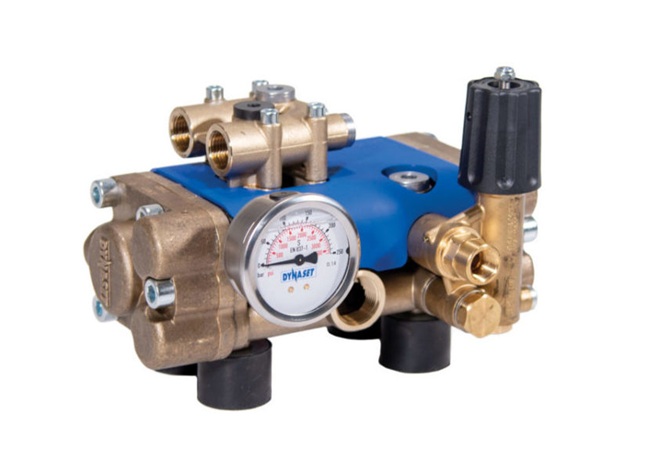 High-pressure water pump output is described in two figures: pressure (measured in PSI or bar) and flow rate (measured in GPM or liters per minute). Together, these determine cleaning power and coverage speed, and the right combination depends heavily on the task.
- Street and surface cleaning typically calls for moderate pressure and higher flow, favoring coverage speed and water volume over sheer pressure.
- Demolition and construction dust suppression benefits from a fine, wide-coverage spray, often achieved with lower pressure and a nozzle designed for atomization rather than a tight, high-pressure jet.
- Quarrying and crushing dust control often needs continuous-duty output built for long run times in a harsh, particulate-heavy environment.
- Subsea and saltwater cleaning requires pump components and seals built to handle saltwater exposure without accelerated wear.
Getting the pressure and flow combination wrong in either direction causes problems: too little pressure and the pump can’t cut through the material it’s meant to clean or the dust it’s meant to suppress; too much pressure or flow for the application wastes hydraulic power the machine could be using elsewhere, and can shorten pump life under conditions it wasn’t sized for.
Matching Pump Size to Available Hydraulic Power
Before selecting a pump, it’s worth confirming how much hydraulic flow and pressure the host machine can actually spare for an attachment. A pump that’s undersized for the available hydraulic supply leaves performance on the table, while one that’s oversized can draw more flow than the machine’s auxiliary circuit is rated to provide, straining the system.
Dynaset’s HPW series covers this range with multiple displacement classes, from compact units suited to smaller service vehicles and skid steers up to high-output models built for continuous industrial duty. Hydra-Power Systems stocks a range of these units and the seal kits, water valve kits, and flow limiters that keep them running, so sizing a pump to a specific machine and application is a straightforward conversation rather than a guessing game.
Why Hydraulic Water Pumps Make Sense for Fleet Operations
Beyond the pressure and flow calculation, hydraulic-driven water pumps offer a few practical advantages for fleets running multiple pieces of equipment:
- No secondary engine to maintain. Eliminating a standalone gas or diesel engine removes a whole category of fuel, oil changes, and engine repairs from the maintenance schedule.
- Compact footprint. These units are built to mount directly to mobile equipment without significant added bulk.
- Emission-free operation. Since the pump draws power from the host machine’s existing hydraulic system, it doesn’t add a second combustion source.
- Reduced downtime. Fewer components running independently means fewer things that can fail on their own schedule.
Sourcing the Right Hydraulic Water Pump
Hydra-Power Systems stocks Dynaset’s line of hydraulic-driven high-pressure water pumps, including multiple HPW models sized for everything from mobile service work to continuous industrial and subsea cleaning duty, along with the seal kits, water valve kits, and flow limiters needed to keep them running. Our team can help match pump displacement and pressure output to a specific machine’s available hydraulic capacity and the application it needs to support.
Learn more on our Dynaset page.