

Sun Hydraulics counterbalance valves cover more configurations today than ever, giving engineers new ways to balance stability, efficiency, and available panel space. Sun Hydraulics, the industry’s leading load-holding valve manufacturer, just made its counterbalance technology available in the smallest, lightest package it’s ever offered. Launched in December 2025, the 0-Series (CBZA and CAZA) packs a full 6,000 psi (420 bar) maximum setting into Sun’s compact T-163A cavity, a footprint built specifically for equipment where every cubic inch matters. For marine systems, mobile machinery, compact hydraulic tools, and construction attachments, where panel space and envelope size are often the tightest constraint in the whole circuit, that’s a meaningful shift in what’s possible without giving up load-holding performance.
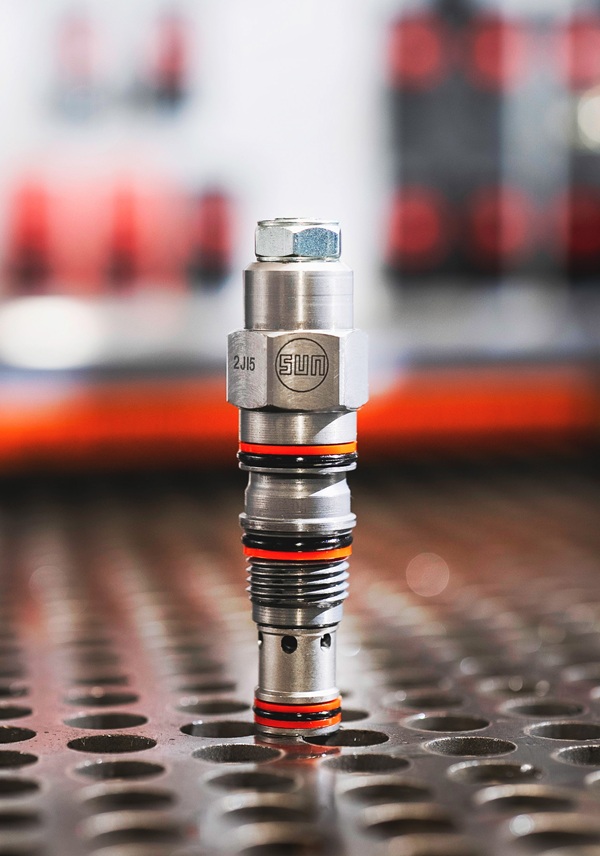 Anyone who has watched a boom stall halfway down, or felt a load “ratchet” instead of lowering smoothly, already understands why counterbalance valves matter. These cartridge valves hold a load in place against gravity or an overrunning force, then release it in a controlled, predictable way. Get the selection wrong, and you’re looking at instability, heat, or a machine that simply won’t hold still. Get it right, and the equipment moves the way the operator expects, every time.
Hydra-Power Systems distributes Sun Hydraulics’ full product line, including its counterbalance valve lineup, and as an authorized Sun distributor with the largest Sun Hydraulics inventory in the USA, we stock the models most mobile, industrial, and OEM customers need on hand. Below is a practical look at how these valves work, the families Sun offers, and how to think through a selection.
What a Counterbalance Valve Actually Does
A counterbalance valve is a load-holding device. It sits between the directional valve and the actuator, blocking reverse flow until pilot pressure, working inversely to the load pressure, opens it. Light loads need more pilot pressure to crack the valve open; heavy loads need less. That “inverse pilot ratio” is what lets a single valve setting handle a range of loads without letting the actuator run away.
Counterbalance valves also build in a relief function from the load side back to the inlet side, which protects the system from load-induced or thermal overpressure. Sun’s cartridges are rated for operating pressures up to 5,000 psi (350 bar) and flow capacities up to 120 gpm (460 L/min.), with some four-port models rated to 6,000 psi (420 bar).
It’s worth distinguishing counterbalance valves from pilot-to-open check valves, since the two get confused. A pilot-to-open check is a non-modulating, on/off device: it’s either holding the load or letting it move, with no fine control in between. A counterbalance valve modulates, which is what gives it the ability to control speed and deceleration rather than just lock a position.
This kind of precise, modulated control is also why counterbalance valves show up so often as building blocks inside larger custom circuits. If your application needs several load-holding, sequencing, or directional functions working together in a single compact assembly, it’s worth a look at our motion control manifolds, which are designed around exactly this kind of precision actuator control.
Sun’s Counterbalance Valve Families
Sun has expanded well beyond a single valve line, and picking the right family is often the difference between a stable machine and one that hunts or oscillates under load.
Standard Counterbalance (CB**) is the industry-standard line and the one most engineers reach for first. It’s a non-vented, poppet-and-piston design available across multiple frame sizes, pilot ratios, and flow gains. Within this family, the CBCA-LHN is one of the most widely used and stocked configurations for general mobile and industrial load-holding applications, and it’s one of the SKUs Hydra-Power Systems keeps on hand in volume for exactly that reason. It’s featured on our list of top 10 stocked Sun Hydraulics components, if you want a broader view of what we keep ready to ship.
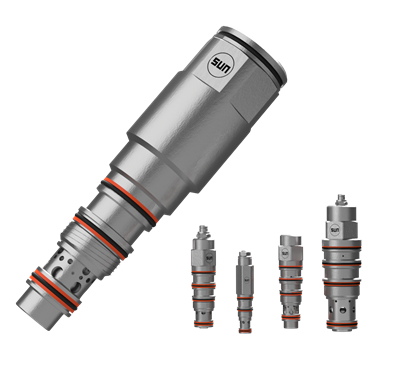 LoadAdaptive™ (CE**) is Sun’s newer, patent-pending evolution of the CB** line. These are multi pilot-ratio valves that adapt to operating conditions, which means you’re no longer forced to choose between a low pilot ratio for stability and a high one for efficiency. LoadAdaptive valves can cut pilot pressure requirements by up to 30% compared to standard counterbalance valves, and they’re currently available in Sun’s Series 1 (15-gpm) frame size as a direct replacement for CB** valves.
Vented Counterbalance (CW** and CA**) valves add a fourth port (or, on the three-port CA** version, an atmospheric vent) that makes the valve insensitive to back pressure at the inlet. Back pressure on a standard non-vented valve raises the effective setting by a factor of 1 plus the pilot ratio times the back pressure, which can destabilize a system with significant or fluctuating back pressure. Vented valves solve that, and they’re the right call in regenerative circuits, with meter-out directional or proportional valves, and in master-slave setups. Two models (CWCL, CWCG) are rated to a 6,000 psi maximum setting.
Load-Reactive Load Control (MB** and MW**) valves function as a counterbalance valve that seats like a poppet and modulates like a spool, with a built-in dampening device that smooths the opening while allowing the valve to close quickly. These are the valves to reach for when a properly sized low-ratio CB** or CW** still isn’t stable enough, or when minimum load pressures exceed 1,000 psi.
LoadMatch™ (MB*P, MW*P, MA*P) takes that M-valve performance a step further with a self-adjusting control. The valve setting dynamically tracks load pressure while still holding a fixed thermal relief setting, which allows for lower, more consistent pilot pressures regardless of how much the load varies. It’s a strong fit for repetitive lift-lower-lift duty cycles where energy efficiency and predictable modulation both matter.
0-Series (CAZA and CBZA) is the newest addition to the lineup, launched in December 2025 and built for Sun’s compact T-163A cavity. It packs a 6,000 psi (420 bar) maximum setting and 7.5 gpm (30 L/min.) flow capacity into a notably smaller, lighter footprint than Sun’s standard counterbalance offerings, at a 3:1 pilot ratio. That combination of full-pressure performance and a reduced envelope makes it a strong fit for marine hydraulic systems, mobile machinery, compact hydraulic tools, and construction attachments, anywhere panel space or overall unit weight is at a premium. The CAZA variant features an atmospherically referenced spring chamber, making it well suited to applications with consistently high or dynamic back pressure at the valve’s inlet port, without the larger envelope of a standard vented valve.
Getting the Pilot Ratio Right
Pilot ratio is the single biggest lever for balancing stability against efficiency. Lower pilot ratios generally give better motion control and stability, especially on springy systems with high inertial loads, but they sacrifice some efficiency since more energy goes into overcoming the valve rather than moving the load. Higher pilot ratios improve efficiency and reduce heat generation, but at the cost of stability and smooth control.
A few practical rules of thumb carry through Sun’s application guidance:
Always use the lowest pilot ratio that still meets the application’s efficiency needs. The lower the ratio, the better the control.
On motor circuits, higher pilot ratios can provide adequate dynamic control, but spring-applied brakes should still lock the load in a static position, since motors leak.
The 10:1 pilot ratio should be reserved for motor circuits or situations that specifically call for that level of pilot-operated check equivalence.
Slightly undersize rather than oversize a counterbalance valve. Its job is to create a pressure drop, and an oversized valve compromises both gain and stability.
Sun’s counterbalance cartridges are tested to reseat at 85% of the cracking pressure, with a maximum leakage spec of 5 drops per minute at reseat pressure. Set correctly, at roughly 1.3 times the maximum load pressure, a counterbalance valve should never see more than about 77% of its setting during normal operation, which is why it can be considered a zero-leak device in practice.
Why It’s Worth Getting This Right the First Time
Counterbalance valves are difficult to adjust accurately once they’re already installed on a machine, which is exactly why Sun recommends factory-set cartridges wherever possible. Field adjustment is possible in an emergency, but it requires careful, methodical work: observing maximum load pressure at the actuator, multiplying by 1.3 to find the target setting, and calculating the number of turns from the valve’s published adjustment rate, all while managing real safety risks around pinch points and unexpected machine movement.
That’s the case for getting the selection right at the design stage. The right family, frame size, pilot ratio, and flow gain combination means the valve does its job quietly in the background instead of becoming a troubleshooting project six months into service.
If a counterbalance valve is one piece of a larger system, our team can also help on the power supply side. Take a look at our hydraulic power units if you’re specifying or upgrading the pump, motor, and reservoir package that will be driving the circuit.
Stocked and Ready to Ship
Hydra-Power Systems maintains one of the largest Sun Hydraulics inventories in the country, with distribution centers in Portland, Oregon, and Birmingham, Alabama. That includes the standard CB** line, vented CW**/CA** configurations, and newer additions like the LoadAdaptive™ and 0-Series valves as they become available. If you’re specifying a counterbalance valve for a mobile, industrial, marine, agricultural, or OEM application, browse current stock at inventory.hpsx.com or request an estimate, and our team will help you work through pilot ratio, frame size, and vented versus non-vented options for your specific circuit.