If you’ve spent any time around hydraulic system design, you’ve almost certainly encountered cartridge valves, even if the term itself wasn’t front and center. They’re one of the most widely used building blocks in mobile and industrial hydraulic circuits, prized for their compact size, serviceability, and flexibility. But for engineers newer to fluid power, or OEMs evaluating design options for the first time, the terminology and cavity standards can be confusing.
This guide breaks down what cartridge valves are, how they differ from other valve configurations, the main types you’ll encounter, and how to think about specifying them for your application.
What Is a Cartridge Valve?
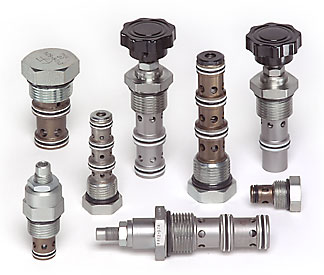
A cartridge valve is a self-contained hydraulic valve designed to screw directly into a machined cavity in a manifold block, rather than being mounted externally and connected with hoses or tubing. The valve’s internal components, poppet, spool, spring, and seals, are housed in a compact cylindrical cartridge that threads into a standardized cavity bore.
This design stands in contrast to traditional stack valves or externally piped valve assemblies, where each valve is a discrete component connected to the rest of the circuit through external plumbing. With cartridge valves, the manifold itself becomes the plumbing: internal drilled passages route fluid between cavities, eliminating much of the external hose and fitting network a comparable stack-valve circuit would require.
Two of the industry’s leading manufacturers of cartridge valve technology are HydraForce and Sun Hydraulics. HydraForce offers an extensive line of pressure, flow, and directional control cartridge valves built to fit industry-common cavity standards. Sun Hydraulics, a Helios Technologies brand, is known for its high-pressure screw-in cartridge valves and its floating cartridge design, which helps the valve tolerate minor variations in cavity machining and reduces the risk of internal binding.
How Cartridge Valves Work
Every cartridge valve consists of a few core elements:
- Cartridge body: the outer shell containing the valve’s internal mechanism, threaded to match a standard cavity size
- Poppet or spool: the moving element that opens, closes, or redirects flow based on pressure or an actuation signal
- Spring: sets the valve’s default position and, in pressure-control valves, determines the cracking or relief pressure
- Seals: maintain pressure integrity between the cartridge and the cavity wall
The valve threads into a cavity machined to a matching size and tolerance. Many manufacturers build to industry-common cavity dimensions, so cartridge valves from different suppliers are often interchangeable within the same cavity family, which gives engineers flexibility during both initial design and long-term maintenance. Sun Hydraulics is a notable exception: Sun designs its cartridges around its own cavity family, which is widely used across the industry and supported by its own consistent sizing across the product line. Knowing which cavity family a manifold is built around is one of the first things to confirm when specifying valves.
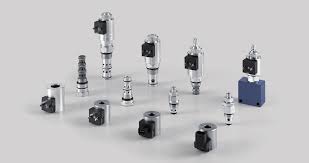
Actuation varies by valve type. Some cartridge valves are purely hydraulically actuated, responding to pressure differentials within the circuit. Others incorporate electro-hydraulic actuation, using a solenoid or more advanced electronic control. HydraForce’s Innercept® digital proportional control uses closed-loop electronic feedback to precisely modulate flow and pressure in real time, while Sun Hydraulics’ FLeX Series electro-hydraulic cartridges pair with Sun’s electronic drivers and controls to deliver responsive, precise solenoid-operated performance.
Common Types of Cartridge Valves
 Cartridge valves are generally grouped by function:
Directional control valves route flow between different paths in a circuit, controlling which actuator receives flow and in which direction. These range from simple two-position, on/off designs to proportional valves capable of infinitely variable flow control. For a deeper look at how these valves are packaged into complete assemblies, see our guide to directional control valve manifolds.
Pressure control valves manage pressure within a circuit. This category includes relief valves, which protect the system from overpressure; reducing valves, which lower pressure to a downstream branch; and sequence valves, which control the order in which circuit branches actuate.
Flow control valves regulate the rate of flow to an actuator, independent of pressure changes elsewhere in the circuit. These are critical in applications where actuator speed needs to remain consistent regardless of load.
Check valves and logic elements allow flow in one direction while blocking it in the other, or combine with pilot signals to perform more complex logic functions within compact packages.
Both HydraForce and Sun Hydraulics offer product lines spanning all of these categories. HydraForce adds advanced electro-hydraulic controls for applications that demand precise, digitally modulated performance, while Sun is especially well known for its pressure control and load-holding valves, including counterbalance valves used in demanding mobile applications. Several of these appear on our list of top 10 Sun Hydraulics components.
Why OEMs Choose Cartridge Valves
Compact footprint. Because cartridge valves screw directly into a manifold rather than requiring external mounting and plumbing, they allow for significantly more compact circuit designs. This matters in mobile equipment and space-constrained applications where every cubic inch counts.
Reduced leak points. Every hose connection and fitting in a hydraulic circuit is a potential leak path. Cartridge valve manifolds consolidate the circuit into a single machined block with internal passages, cutting down dramatically on the number of external connections and the maintenance headaches that come with them, one of the key ways custom manifolds reduce total cost of ownership.
Serviceability. Individual cartridges can be removed and replaced without disturbing the rest of the manifold or circuit, simplifying troubleshooting of issues like slow actuation and reducing downtime compared to circuits where a failed valve means re-plumbing external connections.
Interchangeability and standardization. Established cavity families mean engineers can plan around well-documented, widely supported designs for the life of a program. This is particularly valuable for OEMs managing long production runs, where component availability and sourcing options matter over years, not just at initial design.
Scalability across production volumes. Cartridge-based manifold design scales cleanly from small pilot runs to full production, since the manifold and valve selection can be adjusted without redesigning the entire circuit architecture.
Specifying Cartridge Valves for Your Application
A few questions help narrow down the right cartridge valve selection for a given circuit:
What function does the circuit need? Directional control, pressure regulation, flow control, or some combination will point toward different valve families from the start.
What actuation method fits the application? Simple on/off hydraulic actuation may be sufficient for some functions, while applications requiring precise, variable control, like boom positioning or load-sensing systems, benefit from proportional or digitally controlled valves.
What cavity family does the manifold use? Confirming whether a manifold is built around industry-common cavities, Sun cavities, or both avoids costly redesign later, especially on custom-machined manifolds.
What are the pressure, flow, and environmental requirements? Operating pressure range, flow rate, fluid type, and ambient conditions (temperature, contamination exposure, vibration) all influence valve selection.
This is where working with an engineering-capable distributor pays off. Getting cavity selection, valve sizing, and circuit design right the first time saves significant cost and delay compared to troubleshooting a mismatched design after manifolds are already machined.
Cartridge Valves and Custom Manifold Design
Cartridge valves rarely operate in isolation. In most OEM applications, they’re integrated into a custom hydraulic manifold designed around the specific circuit requirements of the machine. This is where cartridge valve selection and manifold design become inseparable: the manifold’s internal passages are engineered around the exact cavities, flow paths, and pressure zones the application demands.
At Hydra-Power Systems, our Portland Build Center designs and machines custom manifolds in-house, incorporating cartridge valves from partners like HydraForce and Sun Hydraulics into circuits engineered for each customer’s specific application, whether that’s mobile equipment, industrial machinery, or a specialized system built for marine or agricultural use.
Work With an Authorized HydraForce and Sun Hydraulics Distributor
As an authorized distributor for both HydraForce and Sun Hydraulics, Hydra-Power Systems stocks a broad range of hydraulic components, including cartridge valves from two of the industry’s most trusted names, and provides the engineering support to help you select the right components for your circuit, not just the right part number. You can check current availability anytime through our live inventory. Whether you need HydraForce valves built to industry-common cavities, Sun Hydraulics’ floating-design cartridges for high-pressure applications, or a manifold that draws on both, our team can help you navigate cavity families, actuation options, and manifold integration from concept through production.
Contact us to talk through your application, or request an estimate on HydraForce or Sun Hydraulics cartridge valves for your next build.